Sunday, January 13, 2013

INFUS BUAH PISANG BERKALSIUM TINGGI DARI LIMBAH TULANG IKAN TULANG AYAM DAN CANGKANG TELUR (ISPO 2012)


 ABSTRAK


Ade Nur Azizah dan Richa Rachmawati Afag. 2011.Infus Buah Pisang Berkalsium Tinggi dari Limbah Tulang Ikan, Tulang Ayam, dan Cangkang Telur. Bidang: Lingkungan. Pembimbing: Dwi Eldina, Kuntoro Budiyanto

Kalsium merupakan mineral yang terdapat ditubuh dalam jumlah yang banyak. Namun sering kali banyak orang tidak begitu memperdulikan tentang pentingnya kalsium bagi tubuh, karena menurut  sebagian besar masyarakat kalsium hanya terdapat pada susu yang relatif mahal untuk dikonsumsi dalam jangka waktu panjang. Akibatnya, banyak warga yang mengalami berbagai macam penyakit yang disebabkan karena kurangnya asupan kalsium.Padahal kita juga  dapat mengkonsumsi pisang sebagai alternatif untuk menambah kalsium bagi kesehatan tubuh kita. Untuk mempermudah masyarakat dalam mendapatkan asupan kalsium yang cukup, maka kami melakukanpenelitian ini. 
Rumusan masalah yang kami ambil antara lain bagaimana konsep pemanfaatan limbah organik (tulang ikan,tulang ayam,dan cangkang telur) sebagai limbah yang bermanfaat, bagaimana potensi limbah organik dalam membentuk kalsium yang tinggi pada buah pisang dan bagaimana mengaplikasikan limbah organik terhadap tanaman pisang. Tujuan yang hendak dicapai adalah memaparkan konsep pemanfaatan limbah menjadi sesuatu yang bermanfaat, memaparkan potensi limbah organik dalam membuat kalsium yang tinggi pada tanaman pisang, serta tahap pengaplikasian limbah organik terhadap pisang muda yang diharapkan dapat mengurangi masalah kekurangan kalsium.  
Penelitian ini dilakukan disekitar lingkungan SMA Semesta dan analisis dilakukan di Laboratorium Kimia Unnes, dengan pertimbangan di lingkungan  sekitar sekolah (tepatnya di dapur) banyak limbah yang  tersedia setiap hari yang dapat diteliti dan dikelola lagi. Penelitian ini dilakukan pada bulan Oktober-Desember 2011. Variabel bebas dalam penelitian ini adalah banyaknya kadar kalsium yang ada di limbah tulang ikan teri, cangkang telur, dan tulang ayam dan yang menjadi variable terikat dalam penelitian ini adalah banyaknya ion kalsium yang terdapat dalam buah pisang setelah diberi perlakuan. 
Dari pengujian sampel, diperoleh hasil yang mengandung kalsium dalam pisang yang diinfuskan 1% limbah tulang diperoleh rata-rata638.3334 mg/kg sampel dan yang diinfuskan 2% limbah tulang diperoleh rata-rata 898.3332mg/kg sampel , lebih tinggi dibanding perlakuan kontrol dengan rata-rata  388.3334 mg/kg sampel , sedangkan dengan pemberian Kalsidek diperoleh kandungan kalsium dengan rata-rata sebesar  828.3332 mg/kg sampel. Dengan kenaikan kadar 1% kalsium infus  meningkat sebesar 64,337% dibanding kontrol, sedangkan pisang dengan kadar infus 2 % kalsium limbah tulang meningkat sebesar 131,33% dibandingkan kontrol. Disimpulkan bahwa buah pisang dengan perlakuan 2% limbah (tulang ikan, tulang ayam dan cangkang telur) mengandung kalsium lebih tinggi dibandingkan perlakuan kontrol.


PENGARUH GENJER ( Limnocharis flava) TERHADAP DAYA SERAP POLUTAN DAN KETERSEDIAAN OKSIGEN PADA SUMBER AIR BAKU (PDAM) (ISPO 2012)


PENGARUH GENJER ( Limnocharis flava)TERHADAP DAYA SERAP POLUTAN DAN KETERSEDIAAN OKSIGEN PADA SUMBER AIR BAKU (PDAM)
The Influence of Genjer (Limnocharis flava) to The Absorptive pollutant and The Avaibility of Oxygen in Source of Raw Water (PDAM).

ABSTRACT
Hummaira Atthirah Manda and Aidah fithriah. 2011. The Influence of Genjer (Limnocharis flava) to The Absorptive pollutant and The Avaibility of Oxygen in Source of Raw Water (PDAM). Subject :Environmental. Supervisors : Dwi Eldina and Kuntoro budiyanto


Environment Pollution is a problem about our safety, our health, and our life. One of them is water pollution. Water pollution is the main global problem from international until private water sources and wells. Whether it is polluted because of the industrial waste,household waste,pesticide waste,and others. It is dangerous for human health as the consumer. This research utilizes genjer (Limnocharis flava) that will be applied to produce rawwater that isn’t polluted and contain much dissolved oxygen anymore can be a solution. Finally we can have good quality of water. The problem formulations which are done are: whether genjer (Limnocharis flava) is useful in overcoming the polluted water, whether genjer (Limnocharis flava) can help to add oxygen into source of raw water and Can genjer (Limnocharis flava) absorb the pollutant. The purposes of this research are to know whether genjer (Limnocharis flava) is useful in overcoming the polluted water, to test genjer (Limnocharis flava) that may add oxygen into water, and to prove genjer (Limnocharis flava) whether can absorb the pollutant. As the independent variable that is the amount of pollutant as the sample, and the dependent variables are the amount of pollutant that is absorbed by genjer (Limnocharis flava) and the amount of dissolved oxygen in the sample water. This research has been done in the area of SMA Semesta Semarang and chemistry laboratorium of UNNES since October to December 2011. The research uses three treatment experiments,each pollutant solution of detergen,urea and controlled water. Afterthat,it is observed by using AAS (Atomic Absorption Spectroscopy) to test how much metal can be absorbed by the  plant. Based on the research, Ph average is neutral that inclined to base. Meanwhile BOD doesn’t have different between detergent water and urea water waste but on the sample genjer (Limnocharis flava) that is  planted on urea water waste and sample genjer that is planted on detergent water waste are none. The highest amount of dissolved Oxygen on raw water that is planted by genjer is 64.1 ppm. It is higher than controlled water treatment. It shows that genjer (Limnocharis flava) can give oxygen to raw water. The highest amount of COD ( Chemical Oxygen Demand) is on raw water that is planted by genjer is 533 ppm. Meanwhile amount of COD on sample urea water and detergent water are lower. Detergen that is contained on all sample is none except sample of genjer (Limnocharis flava) that is planted on detergent water contain 172.129 ppm phospate ion. This is higher than the others sample. For amount of ammonia, all sample is none, except genjer (Limnocharis flava) that is planted on urea water that have 0.166 ppm. For amount of Alkyl Benzene Sulfonate, all sample is none. It is expected that people don’t use detergent, but use concentrate soap.The conclusion is genjer (Limnocharis flava) can absorb detergent and urea waste and supply oxygen.

Keywords : Genjer (Limnocharis flava), water, dissolved oxygen, water pollutant.

The Influence of Genjer (Limnocharis flava) to The Absorptive pollutant and The Avaibility of Oxygen in Source of Raw Water (PDAM) (ISPO 2012)

 The Influence of Genjer (Limnocharis flava) to The Absorptive pollutant and The Avaibility of Oxygen in Source of Raw Water (PDAM)

 ABSTRACT
Hummaira Atthirah Manda and Aidah fithriah. 2011. The Influence of Genjer (Limnocharis flava) to The Absorptive pollutant and The Avaibility of Oxygen in Source of Raw Water (PDAM). Subject :Environmental. Supervisors : Dwi Eldina and Kuntoro budiyanto


Environment Pollution is a problem about our safety, our health, and our life. One of them is water pollution. Water pollution is the main global problem from international until private water sources and wells. Whether it is polluted because of the industrial waste,household waste,pesticide waste,and others. It is dangerous for human health as the consumer. This research utilizes genjer (Limnocharis flava) that will be applied to produce rawwater that isn’t polluted and contain much dissolved oxygen anymore can be a solution. Finally we can have good quality of water. The problem formulations which are done are: whether genjer (Limnocharis flava) is useful in overcoming the polluted water, whether genjer (Limnocharis flava) can help to add oxygen into source of raw water and Can genjer (Limnocharis flava) absorb the pollutant. The purposes of this research are to know whether genjer (Limnocharis flava) is useful in overcoming the polluted water, to test genjer (Limnocharis flava) that may add oxygen into water, and to prove genjer (Limnocharis flava) whether can absorb the pollutant. As the independent variable that is the amount of pollutant as the sample, and the dependent variables are the amount of pollutant that is absorbed by genjer (Limnocharis flava) and the amount of dissolved oxygen in the sample water. This research has been done in the area of SMA Semesta Semarang and chemistry laboratorium of UNNES since October to December 2011. The research uses three treatment experiments,each pollutant solution of detergen,urea and controlled water. Afterthat,it is observed by using AAS (Atomic Absorption Spectroscopy) to test how much metal can be absorbed by the  plant. Based on the research, Ph average is neutral that inclined to base. Meanwhile BOD doesn’t have different between detergent water and urea water waste but on the sample genjer (Limnocharis flava) that is  planted on urea water waste and sample genjer that is planted on detergent water waste are none. The highest amount of dissolved Oxygen on raw water that is planted by genjer is 64.1 ppm. It is higher than controlled water treatment. It shows that genjer (Limnocharis flava) can give oxygen to raw water. The highest amount of COD ( Chemical Oxygen Demand) is on raw water that is planted by genjer is 533 ppm. Meanwhile amount of COD on sample urea water and detergent water are lower. Detergen that is contained on all sample is none except sample of genjer (Limnocharis flava) that is planted on detergent water contain 172.129 ppm phospate ion. This is higher than the others sample. For amount of ammonia, all sample is none, except genjer (Limnocharis flava) that is planted on urea water that have 0.166 ppm. For amount of Alkyl Benzene Sulfonate, all sample is none. It is expected that people don’t use detergent, but use concentrate soap.The conclusion is genjer (Limnocharis flava) can absorb detergent and urea waste and supply oxygen.

Keywords : Genjer (Limnocharis flava), water, dissolved oxygen, water pollutant.

Saturday, November 17, 2012


PHOTOSYNTHESIS SUMMARY
Materi fotosintesis dwibahasa

Overview • PHOTOSYNTESIS IS The Process That Feeds the Biosphere

• Photosynthesis – Is the process that converts solar energy into chemical energy
   Fotosintesis adalah Proses yang menyuplai "makanan" untuk Biosphere

• Plants are photoautotrophs – They use the energy of sunlight to make organic molecules from water and carbon dioxide
Tanaman adalah mahluk photoautotrophs - Menggunakan energi sinar matahari untuk membuat molekul organik dari air dan karbon dioksida

• Photosynthesis – Occurs in plants, algae, certain other protists, and some prokaryotes
  fotosintesis - Terjadi pada tumbuhan, alga, protista tertentu lainnya, dan beberapa prokariota

• The leaves of plants – Are the major sites of photosynthesis
 Daun - Adalah situs utama fotosintesis

•


• Chloroplasts – Are the organelles in which photosynthesis occurs – Contain thylakoids and grana
Kloroplas 
- adalah organel di mana fotosintesis terjadi
 - Mengandung tilakoid dan grana


• Photosynthesis is summarized as
• 6 CO2 + 12 H2O + Light energy ® C6H12O6 + 6 O2 + 6 H2 O


• Reaksi Fotosintesis

• 6 CO2 + H2O + 12 energi Cahaya ® C6H12O6 + 6 O2 + 6 H2 O


• Chloroplasts split water into – Hydrogen and oxygen, incorporating the electrons of hydrogen into sugar molecules
• Kloroplas memecah air menjadi - Hidrogen dan oksigen, dan kemudian menggabungkan elektron dari hidrogen menjadi molekul gula

• Photosynthesis is a redox process – Water is oxidized, carbon dioxide is reduced
• Photosynthesis consists of two processes – The light reactions – The Calvin cycle
 • The light reactions – Occur in the grana – Split water, release oxygen, produce ATP, and form NADPH
• Fotosintesis adalah suatu proses reaksi redoks - Air teroksidasi, karbon dioksida berkurang

• Fotosintesis terdiri dari dua proses - Reaksi terang- dan reaksi gelap atau Siklus Calvin

 • Reaksi terang  - Terjadi di grana - Split air, melepaskan oksigen, menghasilkan ATP, dan bentuk NADPH


• An overview of photosynthesis

The light reactions convert solar energy to the chemical energy of ATP and NADPH
Reaksi cahaya mengubah energi matahari menjadi energi kimia ATP dan NADPH


Light – Is a form of electromagnetic energy, which travels in waves
• The electromagnetic spectrum – Is the entire range of electromagnetic energy, or radiation
• The visible light spectrum – Includes the colors of light we can see – Includes the wavelengths that drive photosynthesis


• Cahaya - adalah bentuk energi elektromagnetik, yang bergerak dalam gelombang

• Spektrum elektromagnetik - adalah seluruh rentang energi elektromagnetik, atau radiasi

• Spektrum cahaya tampak adalah
- warna cahaya kita dapat kita lihat
- panjang gelombang lah yang mendorong fotosintesis

• Pigments – Are substances that absorb visible light
• The spectrophotometer – Is a machine that sends light through pigments and measures the fraction of light transmitted at each wavelength
• The action spectrum for photosynthesis – Was first demonstrated by Theodor W. Engelmann


• Pigmen - adalah zat yang menyerap cahaya tampak

• Spektrofotometer - Adalah mesin yang mengirimkan cahaya melalui pigmen dan mengukur fraksi cahaya yang ditransmisikan pada setiap panjang gelombang

• Spektrum aksi untuk fotosintesis - Pertama kali ditunjukkan oleh Theodor W. Engelmann


• Chlorophyll a – Is the main photosynthetic pigment
• Klorofil a - adalah pigmen fotosintesis utama
• Chlorophyll b – Is an accessory pigment
• Klorofil b - Adalah pigmen aksesori

• Other accessory pigments
– Absorb different wavelengths of light and pass the energy to chlorophyll a
-• pigmen aksesori lain berperan- Menyerap gelombang cahaya yang berbeda dan lulus energi untuk klorofil


Apa yang terjadi ketika sebuah pigmen menyerap cahaya

• When a pigment absorbs light
 – It goes from a ground state to an excited state, which is unstable
- • Ketika pigmen menyerap cahaya - elektron tereksitasi dari keadaan dasar ke keadaan tereksitasi, yang tidak stabil

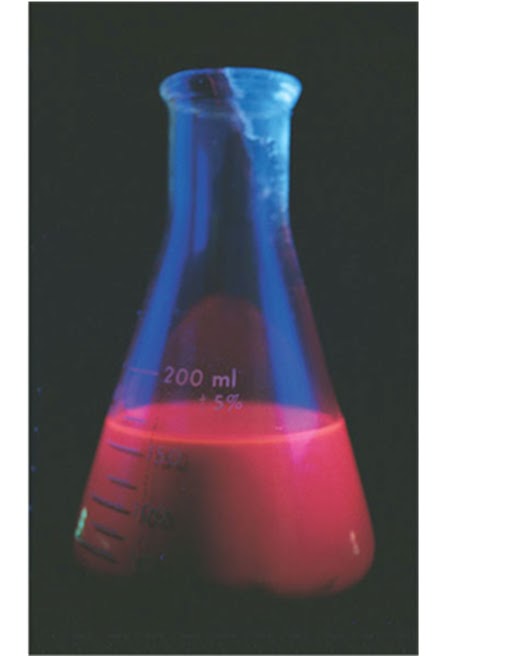
• If an isolated solution of chlorophyll is illuminated – It will fluoresce, giving off light and heat
-Jika cairan isolat klorofil menyala - Ini akan berpendar, memberikan hasil berupa cahaya dan panas

• A photosystem – Is composed of a reaction center surrounded by a number of light-harvesting complexes


• Fotosistem  
- terdiri dari pusat reaksi dikelilingi oleh sejumlah cahaya-panen kompleks 

• The light-harvesting complexes 
– Consist of pigment molecules bound to particular proteins – Funnel the energy of photons of light to the reaction center 

• Kompleks pemanen cahaya 
- Terdiri dari molekul pigmen terikat pada protein tertentu - menyalurkan energi foton cahaya ke pusat reaksi (fotosistem)

• When a reaction-center of chlorophyll molecule absorbs energy – One of its electrons gets bumped up to a primary electron acceptor
• Ketika molekul klorofil reaksi-pusat menyerap energi - Salah satu elektron akan bertemu sampai akseptor elektron primer


•    Noncyclic electron flow
–    Is the primary pathway of energy transformation in the light reactions
•    Produces NADPH, ATP, and oxygen

Siklus non siklik
- adalah jalur utama pengubahan energi matahari (di reaksi terang) untuk menghasilkan    NADPH, ATP dan oksigen


•    Under certain conditions
–    Photoexcited electrons take an alternative path
•    In cyclic electron flow
–    Only photosystem I is used
–    Only ATP is produced

Namun pada kondisi tertentu:
- Eksitasi elektron memakai jalur alternatif yaitu aliran elektron secara siklik
-Di siklus siklik
- hanya fotosistem I yang digunakan
- hanya memproduksi ATP


•    The light reactions and chemiosmosis: the organization of the thylakoid membrane